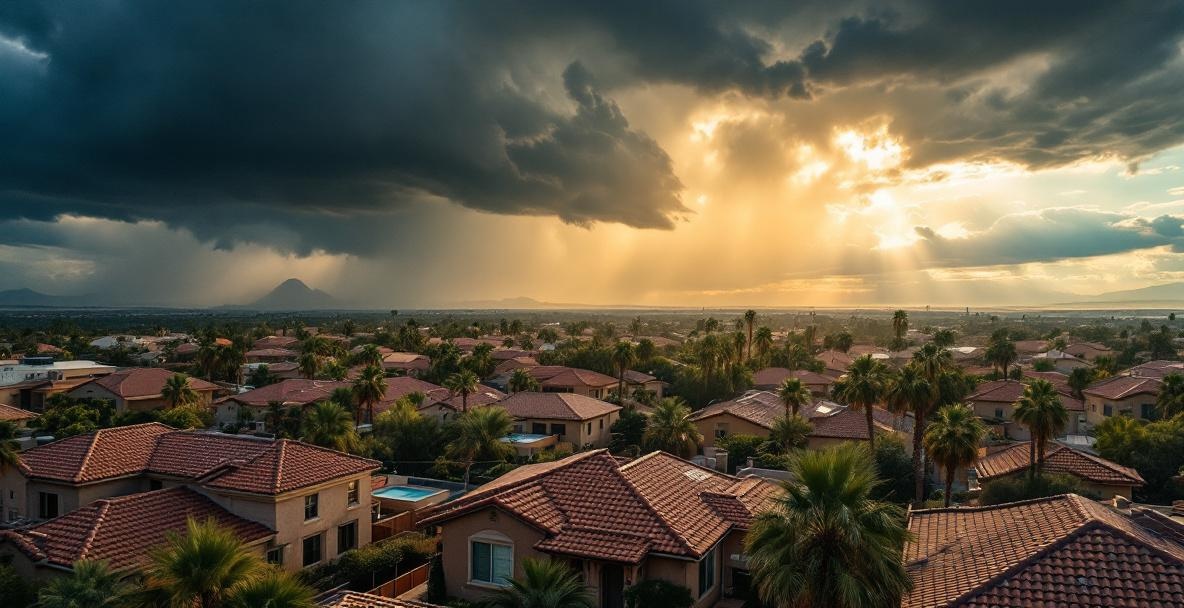
The Arizona Homeowner's Guide to Insurance Claims
Most Arizona homeowners accept their first insurance settlement without question. They trust the number, sign the paperwork, and start repairs — only to discover months later that the payout didn’t come close to covering the actual cost. This guide explains why that happens, what the insurance company isn’t telling you, and what your real options are.
The Reality of Arizona Storms
Arizona’s climate is deceptively brutal on homes. Most homeowners think of weather damage as something that happens in hurricane country — not here. That’s exactly the assumption your insurance company is counting on.
Monsoon Season (June–September)
Arizona’s monsoon season delivers some of the most violent localized weather in North America. Microbursts — sudden downdrafts of wind that can exceed 100 mph — strike without warning, tearing off shingles, lifting roof edges, and sending debris into walls and windows. Hailstorms frequently accompany these systems, pounding roofs with ice that can be the size of quarters or larger. Flash flooding pushes water into foundations, crawlspaces, and wall cavities faster than drainage systems can handle.
Year-Round Heat Damage
Even when the skies are clear, Arizona’s extreme heat is silently destroying your roof. Summer temperatures in the Phoenix metro regularly exceed 115°F. This heat cycles — blistering hot during the day, cooling at night — crack and brittle shingles over time, making them far more vulnerable to the next storm event. By the time a hailstorm hits, your shingles may already be compromised. Adjusters rarely account for this compounded damage.
Wildfire Smoke & Ash
Arizona wildfires don’t have to reach your neighborhood to damage your home. Smoke and ash from fires miles away infiltrate HVAC systems, coat exterior surfaces with corrosive residue, and compromise indoor air quality in ways that require professional remediation. These damages are real, documented, and frequently covered — and almost as frequently missed by insurance adjusters who never set foot inside your house.
The “First Offer” Trap
Here’s what the insurance company doesn’t advertise: The adjuster who knocks on your door works for your insurance company — not for you. Their job is to settle your claim as quickly and cheaply as possible. That’s not cynicism. That’s their job description.
Insurance companies use their own proprietary estimating software, typically Xactimate, programmed with pricing data that routinely lags behind actual contractor costs in your market. In a state like Arizona where demand for roofing and restoration contractors spikes sharply after every monsoon season, those gaps become enormous.
Beyond outdated pricing, company adjusters are working dozens of claims simultaneously. They spend an average of 20–45 minutes on a roof inspection — not nearly enough time to identify the full scope of damage, particularly damage that isn’t visible from the ground or requires interior access to discover.
“The first offer is typically 50–70% less than what repairs actually cost. Most homeowners never know they left money on the table.”
They also benefit from homeowner confusion. Most people have never filed a major property claim before. They don’t know what’s covered, what’s not, how to read a scope of loss, or what fair market pricing for restoration work looks like. The insurance company does. That information asymmetry is worth thousands of dollars — to them.
Damage That Gets Missed in Arizona Claims
Standard insurance inspections routinely overlook damage types that are common in Arizona’s climate — damage that accumulates, worsens, and becomes extremely expensive to fix when not caught early.
- Hail bruising on shingles — Hail impact compresses the granule layer of asphalt shingles without cracking them visibly. From the ground, the roof looks fine. Up close, the shingle is fatally compromised and will fail within 1–3 years, allowing water intrusion directly into decking and attic.
- Wind lift on roof edges — High-velocity monsoon winds get underneath roof edges and fascia, partially unseating flashing and drip edges. Water follows the path of least resistance straight into your wall assembly.
- Smoke and ash residue — Wildfire byproducts coat HVAC intakes, filters, ductwork, and interior surfaces. Left unaddressed, the corrosive chemistry in ash accelerates surface degradation and creates ongoing air quality issues — all documentable and typically covered.
- Water damage behind walls — Monsoon flooding pushes water into wall cavities through unsealed penetrations, windows, and door frames. Moisture trapped behind drywall breeds mold within 24–72 hours. Adjusters who don’t use moisture meters miss it entirely.
- Structural shifts from wind events — Severe wind events can rack a structure — shifting wall framing and roof trusses slightly out of square. This is invisible to a cursory inspection but shows up in doors that don’t close, windows that stick, and cracks that appear weeks or months later.
What Is a Public Adjuster?
A public adjuster is a licensed insurance professional — licensed by the state of Arizona — who represents homeowners (not insurance companies) in the claims process. Think of it as having your own advocate in the room who speaks the insurance company’s language and knows exactly how to counter their arguments with documentation.
A qualified public adjuster conducts a comprehensive inspection — often taking several hours — using moisture meters, thermal imaging, and documentation photography. They prepare a complete scope of loss using current market pricing and submit it to your insurance carrier with supporting evidence. Then they negotiate until you receive a fair settlement.
Public adjusters work on contingency. That means no upfront cost to you. They earn a percentage of the increased settlement they recover. If they don’t recover more than what you were originally offered, you pay nothing.
Real Arizona Claims. Real Results.
These are actual settlements negotiated by Copper State Adjusting for Arizona homeowners who initially accepted — or were about to accept — a lowball offer from their insurance carrier.
| Damage Type | Initial Offer | Our Settlement | Increase |
|---|---|---|---|
| Hail Damage — Roof & Gutters | $12,400 | $34,870 | +181% |
| Water Damage — Monsoon Flooding | $7,800 | $19,200 | +146% |
| Fire Damage — Smoke & Structure | $45,000 | $88,000 | +96% |
Results reflect actual settled claims handled by Copper State Adjusting. Individual outcomes vary based on policy terms, damage scope, and claim circumstances.
Think Your Claim Was Underpaid?
We only get paid when you get paid more — no upfront cost, ever.
Get a free, no-obligation claim review from Copper State Adjusting. We’ll tell you exactly where you stand and what we believe your claim is actually worth.
Takes less than 10 minutes. No commitment required.